
Instrumentation
WE KNOW
We are the key to an issue-free startup
And we know this because we have done it many times before!
Our I&C Specialists wear many hats that go far beyond your typical Technician.
When you contract one of our Team Members, you're getting a person ready for any challenge you can throw at them, and they'll quickly become the person you trust and rely on most to get the job done.
- Construction? We can handle that!
- Commissioning? We got it!
- Maintenance and troubleshooting? That too!
- Name it, there's not a lot we can't handle.
What separates us from the competition? An extensive test to start with, but it's more so the mentality of the people we hire that sets us apart. We don't hire followers; we hire leaders. We hire self-motivated individuals who find solutions instead of roadblocks.
Why we created the I&C Specialist
We wanted to change the way the industry sees an Instrument and Controls Technician. A few years back, we set out to create something that gave clients more bang for their buck than the typical I&C Tech who takes work orders each day and attempts to complete them.
In a plant where there are clear, concise instructions, and documentation is nothing less than perfect, a Technician is all you need. But what if your facility has suffered from years of neglect? Neglect in the form of critical documentation such as P&IDs, Loop Drawings, Spec Sheets, and Motor Control Schematics never being updated? Most facilities assume these documents are up to date and accurate because no one hears otherwise, but in reality, many employees have the mindset that if they found it that way, it's not their job to correct it.
Every so often, someone goes the extra mile to get it all corrected and updated, but that's not the norm. So we gave our I&C Techs some new skills and renamed them Specialists.
What our I&C Specialists have done for clients
Our I&C Specialists are trained to do numerous things the typical I&C Tech doesn't, or even can't, do. They have performed the following functions for our clients:
Developed Scope
- Reviewed DCS alarm logs to evaluate and prioritize the criticality of the alarms, and determined a path forward for corrective action for each system and component-level alarm.
- Reviewed instrumentation to determine whether its installation and condition could lead to an unexpected unit upset or trip, and developed plans to replace it.
- Reviewed plant tank gauging systems for potential points of failure and developed corrective action plans.
- Reviewed plant Fieldbus infrastructure for potential failures and developed a corrective action plan.
- Developed scope for Preventive Maintenance cycles on various units and equipment, including defining the type of work, specifying and ordering parts, building a package for every item in the scope, and providing documentation for commissioning and QC of the items worked.
- Reviewed warehouse stock against field installations and narrowed down the instrument models used onsite, adjusting ordering practices so parts are on hand when an instrument fails, without overstocking and without downtime waiting on replacement parts.
Planned Work
- Performed detailed walkdowns of Instrumentation and Electrical on equipment and areas of upcoming turnarounds, and developed lists of items requiring removal for other crafts, items requiring periodic checkouts, and items needing repair or replacement.
- Turned work lists and scopes into packages with work details that included loop checkout sheets, spec sheets, loop drawings, electrical schematics, P&IDs for Positive Component Identification, identifying photos, part locations, work-in-progress logs, and timelines for performing the work.
- Interfaced with vendors to order parts, and developed MOCs for obsolete parts.
Performed Critical Troubleshooting
- Performed work on SIS and IPF systems, which included retrieving all paperwork required before starting (procedures, data retention forms, inspection forms, logic drawings, P&IDs, written mitigation plans, etc.), reviewing compliance procedures for mistakes before beginning work, understanding the procedure in its entirety, performing a pre-job brief with Operations, ensuring a mitigation plan was in place while the system was bypassed, performing the work without an unintended unit upset or trip, repairing failed instrumentation, returning the system from bypass to normal, and completing all regulatory paperwork required by the site and government agencies.
- Performed work on complex loops, which included identifying such instrumentation before performing work, retrieving documentation (complex loop write-ups, P&IDs, spec sheets, loop drawings, a copy of the control drawing, etc.), performing a pre-job brief with Operations to ensure no unit trip or upset would occur, repairing the critical instrumentation, and returning it to service.
- Identified numerous instruments installed incorrectly in a way that may have kept them from functioning correctly, possibly resulting in a catastrophic failure.
- Identified and corrected numerous engineering errors that left instrumentation either never working since its original installation, or working unreliably.
Procedure Writing
"The intent is not to add bureaucracy. The intent is to slow down at the right moments so that what is intended to happen is what happens, and that is all that happens."
We write procedures for the jobs where there's no room for a mistake, and we write them for the people who will actually do the work. Some of ours run close to 200 pages, because that's what it took to do the job right.
- Live DCS cutovers. Moving control loops, one at a time, from an old DCS to a new one while the unit stays online. Our cutover procedures use Human Performance tools taken from nuclear-fleet practice: STAR self-checking, three-way communication with the phonetic alphabet, concurrent and independent verification, color-coded wire clips so no one touches the wrong loop, and a reverse pre-job brief where a crew member gives the plan back in their own words. Before anyone touches a live loop, the crew runs the whole sequence in a mock session on a non-energized cabinet.
- Burner management and interlock checkouts. End-to-end testing from the field device, through the logic, to the HMI. We don't just test a successful light-off. We simulate the failed ignition, the flame detected during the safe-start check, and the trip, burner by burner.
- Skid and package commissioning. Five-point as-found and as-left calibrations, loop verification all the way to the remote monitoring center, and cause-and-effect testing both online and offline.
We have also written procedures for:
- Implementation of MOCs.
- Jobs with critical steps.
- Work processes that focus on Human Performance and mistake-free work.
- Complex commissioning on items such as motor controls with interlocks to protective relays and/or the control system.
Every procedure we write:
- Has every step initialed and dated by both the performer and the verifier, and timed on live work.
- Has stop points built in. If the field doesn't match the document, work stops and the discrepancy gets logged, not worked around.
- Explains the why: principles of operation, troubleshooting tips, and drawing references right where they're needed.
- Is reviewed by Operations and Maintenance before the work starts.
- Says up front that it is never a replacement for critical thought and common sense.
QC
- Ensure installations meet industry standards as well as local and national code.
- Ensure the client's design and engineering practices are followed.
- Create QC documentation for clients when needed.
- All employees are trained in Good Documentation Practices, and our procedures hold everyone to them:
- All records are filled out in indelible ink. No pencil, no white-out, no scribbles. A mistake gets a single line through it, initialed and dated.
- Every step is signed or initialed and dated at the time it's performed. An unsigned record is an incomplete record.
- Test equipment model, serial number, and calibration date are recorded with the results.
- As-found and as-left readings are both recorded, not just the final number.
- A completed procedure is reviewed by someone who didn't perform the work, to catch omissions and mistakes.
- When field copies are transferred to digital, the actual test dates are kept and the final record is locked as a PDF so nothing can be changed or lost.
Management of Change
- Use the MOC process to replace obsolete instrumentation and to correct incorrect installations or applications, including spec'ing a replacement that meets the approval of Process Control Engineering, Process Engineering, Materials Inspection, and Environmental.
- Take a modification from an idea all the way to service: build a conceptual draft for the MOC committee, then a full package with the correct application, engineering drawings, P&IDs, loop drawings, electrical schematics, and spec sheets, a scope of work for the constructors, and bids from vendors and contractors, then follow it through installation, commissioning, the pre-startup safety review, and placing it in service.
Software and Systems
Proficient with the software used across the industry: SAP for work orders, planning, parts, and using history to identify bad actors; INtools for loops, tags, and spec sheets; electronic MOC and document management systems; DeltaV, Yokogawa, Honeywell TDC 3000 and C300, and ROC controllers; AMS and PRM asset management for commissioning and calibration; AutoCAD for P&IDs; Adobe Pro for redlines; and Excel for forms and tracking.
From scope development, to planning, to procedure writing, to design, construction, commissioning, and startup, finding poor installation issues before they affect reliability is critical!
Section heading: Commissioning of new Instrumentation and Electrical systems, from one of our I&C Managers
One of the most important parts of a project is the commissioning phase. No, wait, let me rephrase that… the most important part of a project is the commissioning phase. It's no secret that the industry is short on truly skilled craftsmen. I have intimate knowledge of this, both from the perspective of the client and from the perspective of a hiring manager.
After being offered a long-term contract position with a client in Illinois, I was asked if it was possible to find I&C Techs who could perform at a high level, as the contractors currently onsite were not living up to the client's expectations. In 2001, I decided to take the opportunity to find the Techs who met the client's expectations, but that proved harder than I thought it would be.
The test I created consisted of nothing more than what I thought a seasoned I&C Tech should know. The problem with that assumption was that the seasoned I&C Techs I interviewed and tested didn't have the baseline knowledge I knew it took to be a successful troubleshooter. It took a lot of time and effort, but eventually there was a candidate here and there who passed the test, and we were finally able to put together a team. The before and after results were night and day.
At that point, we also realized why so many projects had problems with startups, and why units often struggled to stay running. The quality of work needed for a successful first run could not be done by most contractors.
So you want to know what the difference is, right? Well, here's the difference. Let's talk about how a project is generally managed.
First, scope is developed either by the client or the designated Engineering contractor. Then it is put out for bid, where companies attempt to be awarded contracts for the work, often based on the lowest bid. The bids are awarded, and shortly after the kick-off meetings, construction starts. There are two avenues to take at this point.
Avenue A: The contractor constructs, inspects, and commissions their own work, and then turns the completed project over to the client.
Avenue B: The contractor performs their work under the watchful eye of the client, or the client's designated representative. Turnover and commissioning are then handled one of two ways: the client and/or their reps direct the commissioning to ensure the equipment is checked out in a way that proves its functionality, or the client and/or their reps perform the commissioning themselves.
Why am I suggesting you take Avenue B? Because the last thing you want is to think you're about to have a successful startup, only to find out the startup will be hit with numerous delays.
How do I know that will happen? Because I've seen it over and over, and remember, I've tested and interviewed a lot of people in the I&C trade over the last 25 years, so I know who is out there and what they are capable of. The bottom line is this: the contractor you hired to do the construction and commissioning may really be doing their best. They really may be trying to give you a good product. Their Electricians and Technicians may be doing everything they believe to be right, and if there is a good QC person on the job, they are going to tug on wires in the junction box, make sure there's a low-point drain in the conduit and sufficient slope in a transmitter's process tubing, etc., but it's very unlikely they will recognize a design issue.
On large-scale jobs, you're going to end up with people commissioning who know little more than how to simulate a signal to the DCS. That same person is not going to look at a spec sheet for a DP level transmitter and think about whether the range on the sheet makes sense before they simulate the signal to the board.
You would be surprised how many installations we find with the wrong ranges, and there's a simple reason for it. The designer came up with a range based on where the transmitter would be mounted, and the technician is verifying that range is configured into the transmitter, but what no one paid attention to is that the transmitter isn't mounted exactly where it was originally intended to be. It was mounted slightly lower, and to the left, because there was a handrail where it was supposed to go. No one catches this, and on the day of startup you get a deviation alarm because this little error caused your trip transmitter to be off by a few percent, and because it's a trip transmitter, everything is on hold. Now you send a tech to look at the transmitter, and surprise, they find it calibrated perfectly. "No issues" is what they report back to Operations, and that's because they found no issues. To most techs, the range is right and the calibration is correct. Now what?
Remember this number I'm about to tell you. More than ninety-five percent of the I&C Techs I've tested since 2001 could not calculate a simple DP level transmitter range. This is simple instrumentation, and now it's costing you money because you can't start up. How many more things like this are waiting to be found on startup? Did the tech who simulated the signal on the magnetic flow meter recognize that the flow tube was installed with the electrodes vertical instead of horizontal? If not, you're shutting down this new equipment to isolate it, drain it, and rotate the meter. There are so many reasons not to take Avenue A.
Our I&C Specialists find things like this all the time, because it's part of their everyday job. They find things like this because we talk about them daily. They find things like this because we test their knowledge on just about every facet of Instrumentation.
On our last project, the number of design and installation issues our team identified would outright shock you if we showed you our tracking database.
What we do
Our industries

We know
It All Comes Down to One Thing: On Time
WE DON'T CHASE YOUR SCHEDULE, WE IMPROVE IT
Learn more about Data Centers
we know
You expect us to be walk-ons, and we are
WELLHEAD TO MARKET, WE'VE DONE IT ALL.
Learn more about Oil & Gas

We know
If it isn't documented, it didn't happen
AUDIT-READY FROM DAY ONE.
Learn more about Pharmaceutical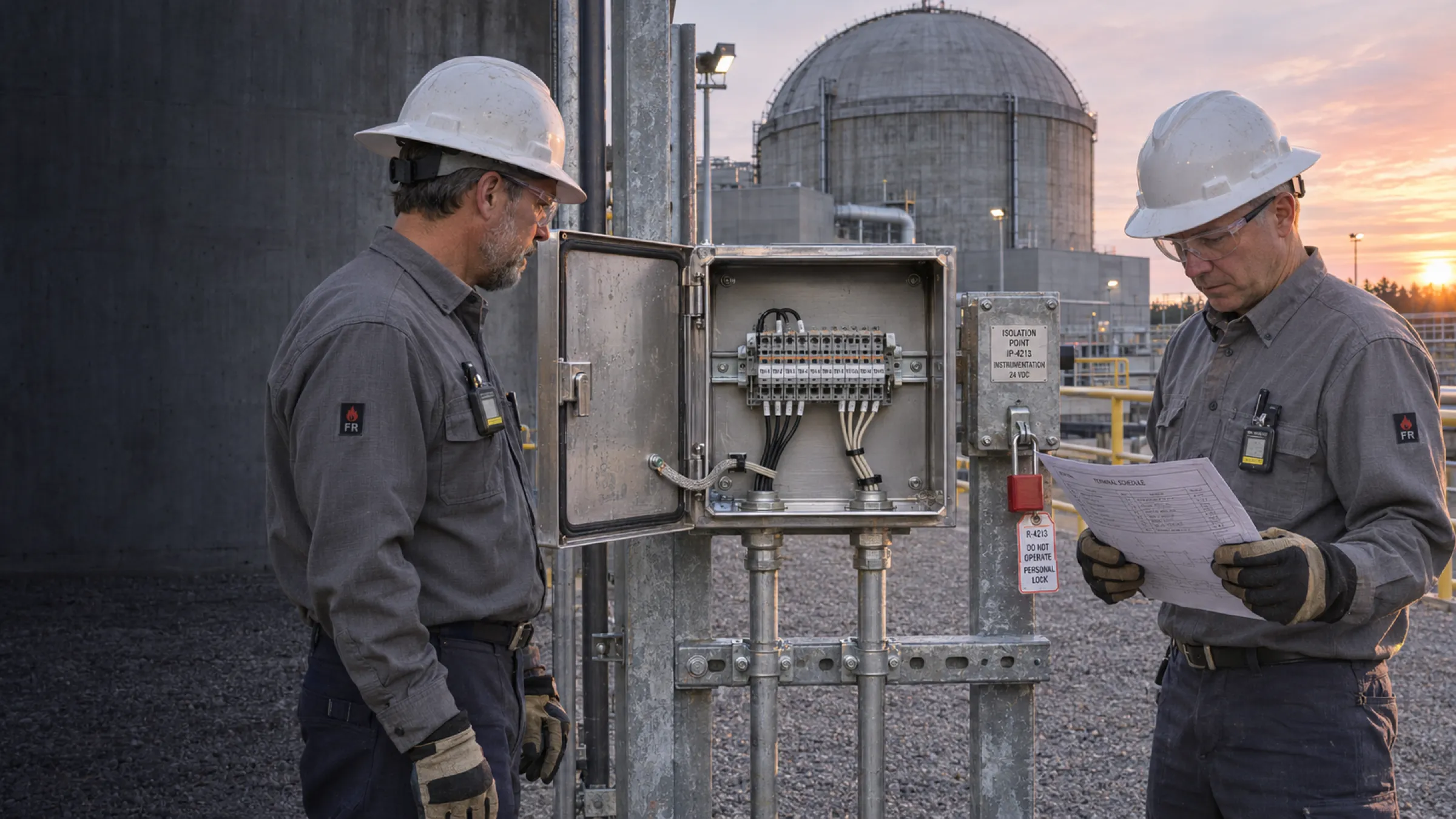
We know
Human performance is as important as technical capability
THE HIGHEST STANDARD THERE IS IS OUR STANDARD.
Learn more about NuclearLet's talk
Have a problem to solve? Want to be more than just an employee? We're ready to listen — 24 hours a day, 7 days a week.